Armored Mobility Readiness Platform

The Weakest Moment Is
After the Vehicle Stops.

Run-flat tire intervention is treated as routine maintenance. In the field, it becomes a personnel safety problem, a readiness failure, and a command-level responsibility.

Field Risk
Intervention Exposure
350+kg
Per Wheel Assembly
3–5 Crew
Manual Requirement
20 Min
Per Tire Downtime
The Hidden Failure Point

The Problem Begins After
Mobility Is Lost.

Armored vehicles are designed to survive damage. Run-flat systems help them keep moving after tire failure. But once the vehicle stops and the tire must be serviced — the real problem starts.

The issue is not the tire itself. It is the intervention window, the personnel exposed, the tools required, and the time lost while the convoy waits, the perimeter holds, and soldiers work under pressure that no maintenance manual accounts for.

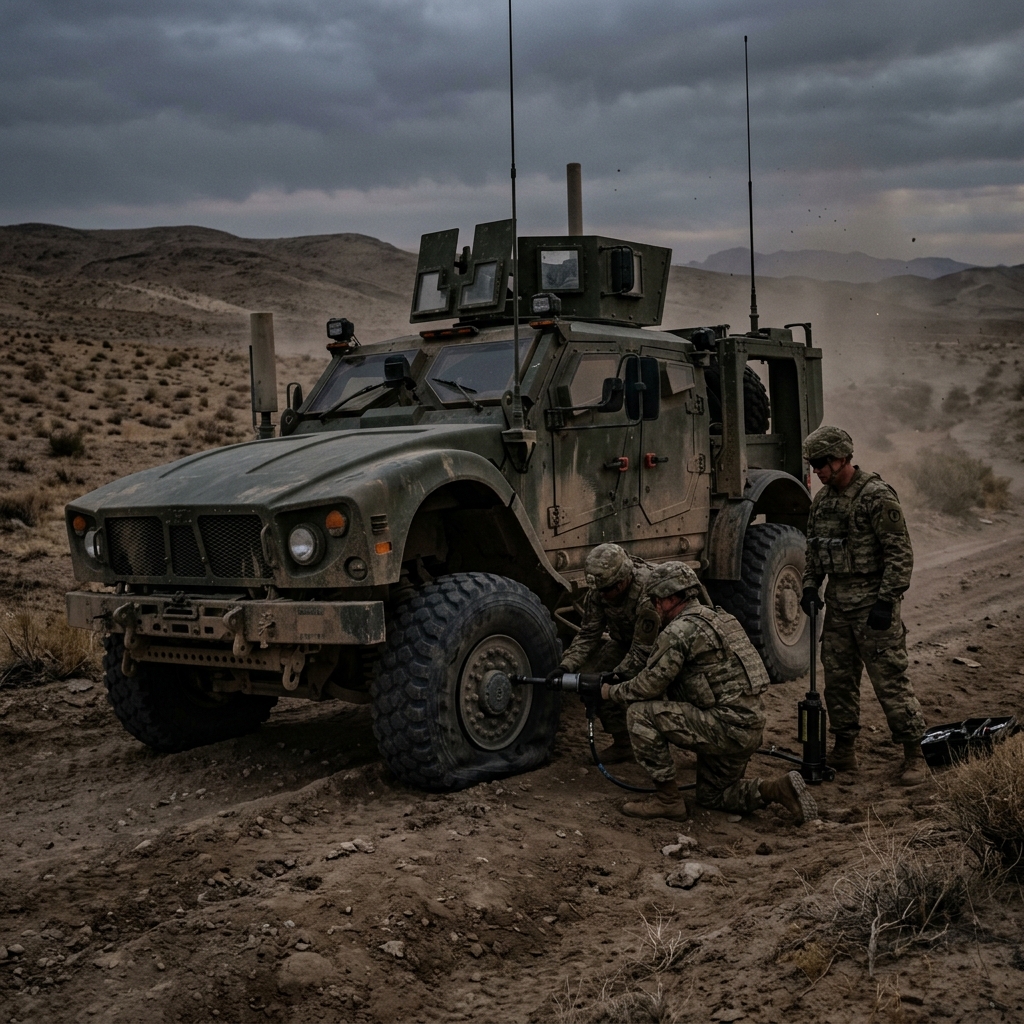
Immobilized armored vehicle in field conditions

Convoy Exposure Window

Every minute of field tire intervention extends the time personnel remain outside armored protection in potentially hostile environments.

Convoy halts compound threat exposure for every vehicle in the column.

Cumulative Injury Risk Under Load

Military tire and run-flat assemblies exceed 150 kg. Manual handling creates cumulative musculoskeletal strain and acute injury risk.

Repeated interventions degrade crew capability across deployment cycles.

Improvised Intervention Risk

Without proper equipment — cranes, hooks, shields, hydraulic aids — crews improvise. Improvisation in pressurized maintenance creates uncontrolled risk.

Uncontrolled rim separation and stored-energy release become the default.

Readiness Loss Under Pressure

Manual run-flat intervention can take hours per wheel. Across a fleet rotation, the cumulative readiness impact is measured in days of lost availability.

Vehicles wait. Missions stall. The maintenance queue becomes the bottleneck.
"This is not just a tire issue. It is what personnel are forced to carry when the support system is not designed for the field."
Field Intervention Capability

The Equipment That Changes
What Happens Next.

When armored vehicles are immobilized, the difference is not the tire — it is how fast, how safely, and with how few personnel the intervention can happen.

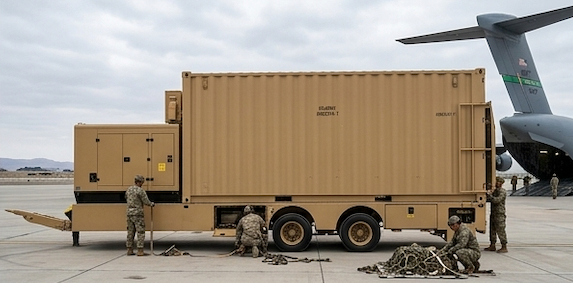
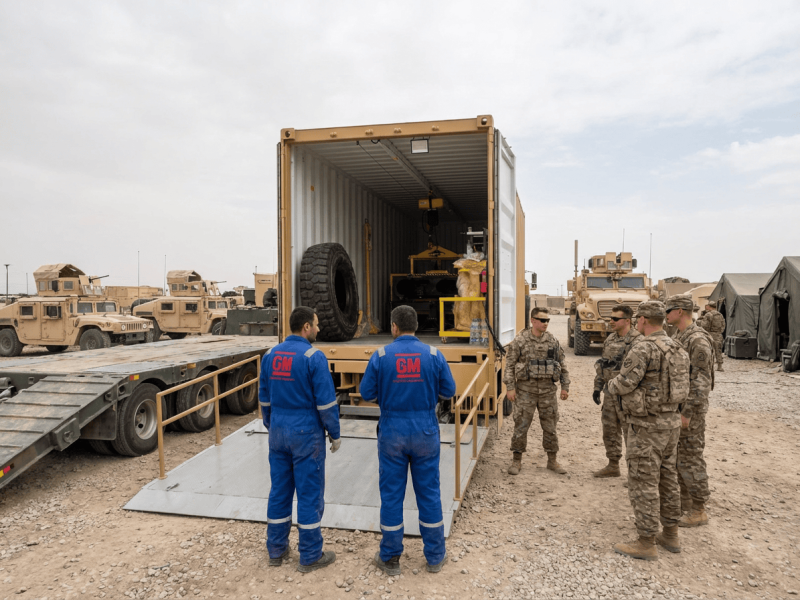
GM Defensive Trailer Model — containerized mobile run-flat tire changing system being deployed at military airfield with C-17 aircraft
Field / Convoy / Forward Position
C-17 Air Transportable
<20min Deployment Ready
Field-Critical Intervention Platform

Trailer Model

Mobile trailer-mounted run-flat tire changing capability. Brings controlled hydraulic intervention directly to the point of need — compressing exposure time and reducing crew dependency.

Near-Location Deployment Rapid transport to convoy halt points and forward bases. No fixed infrastructure required.
Reduced Exposure Time Hydraulic bead break, rim separation, and insert handling replace manual force.
Physical Burden Eliminated 350+ kg wheel assemblies handled through controlled mechanical processes.
1–2 Operators, Not 3–5 Repeatable hydraulic workflows reduce crew dependency significantly.
Engineered for heavy military wheel assemblies with multi-piece rims, pressed-fit run-flat inserts, and high-pressure tire components. Each process step follows a controlled, repeatable hydraulic sequence.
View Deployment Models
Technical Complexity

Why Run-Flat Intervention
Is Not Simple Tire Work

Run-flat systems protect survivability. But servicing them requires controlled force, specialized tooling, and a process designed for components that weigh more than most commercial vehicle wheels.

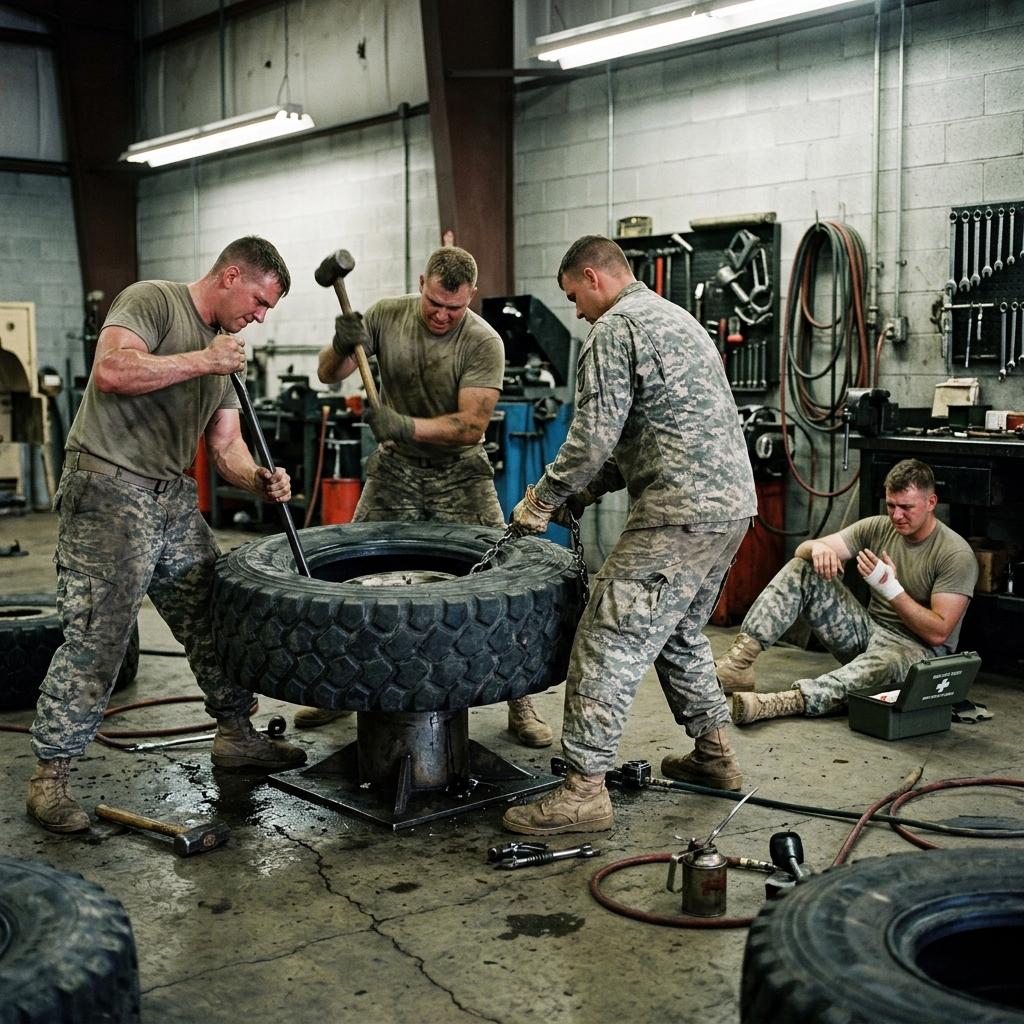
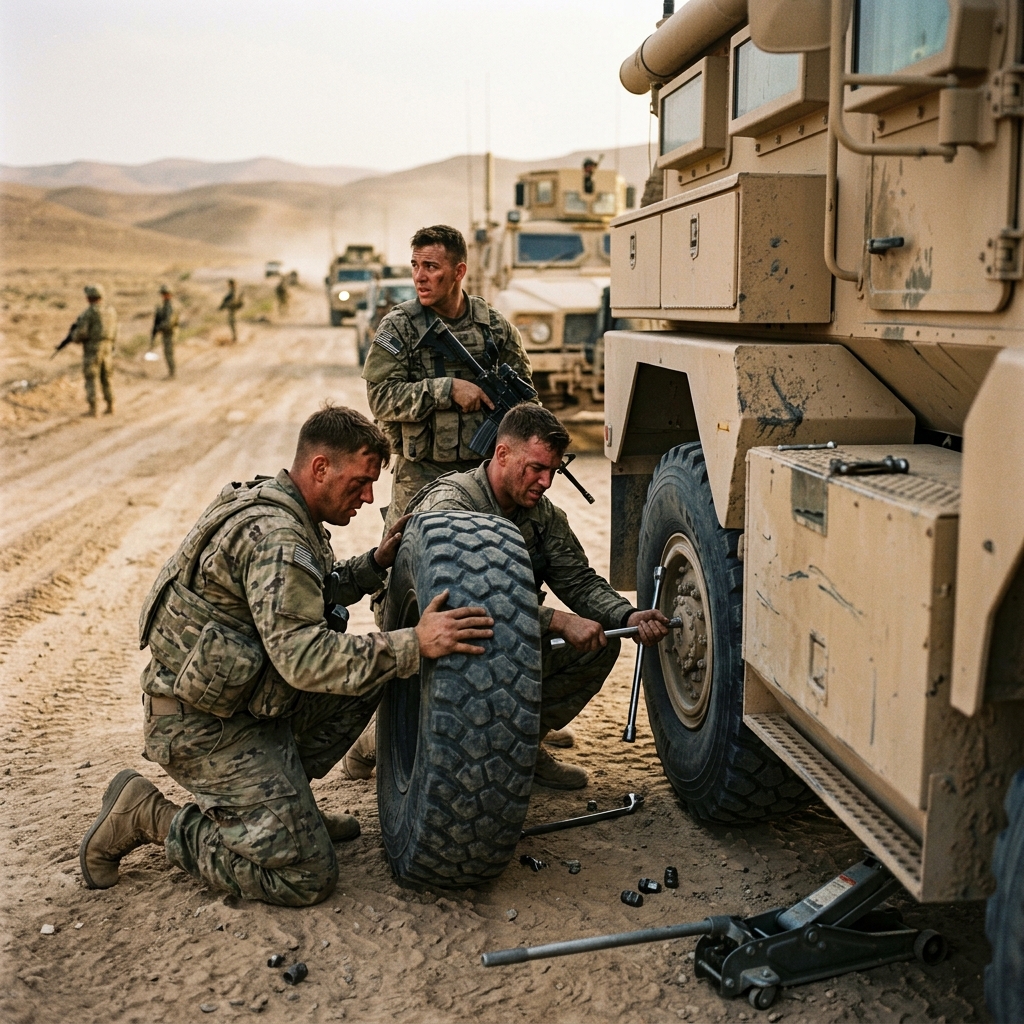
Soldiers struggling to remove run-flat insert in military workshop, injured colleague in background

Wheel Removal

Heavy military wheel assemblies require cranes or lifting aids. Manual removal from axle height creates immediate physical strain.

Tire Deflation & Bead Break

Pressurized components must be carefully deflated. Bead separation on military tires requires significant controlled force.

Rim Separation

Multi-piece rims must be separated under controlled conditions. Lock ring and side ring handling involves stored energy risk.

Run-Flat Insert Removal

Pressed-fit run-flat inserts resist extraction. Removal requires precise, sustained force — any improvisation risks component damage or personnel injury.

Insert Installation & Assembly

New insert must be seated, aligned, lubricated, and pressed into position. Rim reassembly, bead seating, and inflation complete the cycle.

Wheel Reinstallation

Torque application, alignment verification, and vehicle readiness check. The full process repeats for each affected wheel.

Operational Comparison

Legacy Process vs.
Machine-Assisted Intervention

Factor
Manual / Legacy
Machine-Assisted
Intervention Time
Hours per wheel
Significantly reduced
Personnel Required
3–5 trained crew
1–2 operators
Exposure Window
Extended
Compressed
Physical Strain
High — manual heavy lift
Controlled — hydraulic assist
Safety Control
Operator-dependent
Engineered shielding
Repeatability
Variable by crew
Consistent process
Deployment Flexibility
Fixed depot only
Depot, container, trailer
Readiness Impact
Significant downtime
Faster return to service

This is not a maintenance improvement. It is readiness infrastructure.

Command Responsibility
"When the system is not designed for the field, risk transfers to personnel."
Commanders Logistics Officers Procurement Teams Maintenance Leadership

The question is not whether the maintenance will happen. It will. The question is whether your personnel will perform it with controlled equipment — or with improvisation, physical strain, and extended exposure as the default method.

Every deployment without field-capable run-flat intervention capability is a decision to accept that risk. The field will not wait for the system to catch up.

The Modern Approach

From Manual Burden to
Controlled Intervention

Modern hydraulic run-flat tire changing systems replace manual force with controlled mechanical action. The result: reduced personnel burden, improved safety, and faster return to operational readiness.

  • Controlled hydraulic rim separation and bead break
  • Mechanical run-flat insert removal and installation
  • Integrated safety shielding for pressurized operations
  • Reduced crew requirement from 3–5 to 1–2 operators
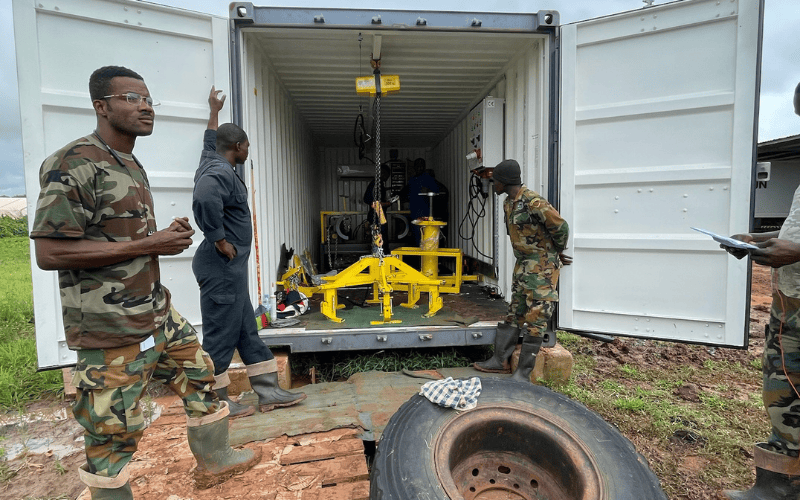
  • Depot, container, and trailer deployment configurations
  • Compatible with heavy military wheel assemblies

GM Defensive's run-flat tire changing systems represent this shift — from manual burden to controlled intervention capability designed for armored fleet maintenance.

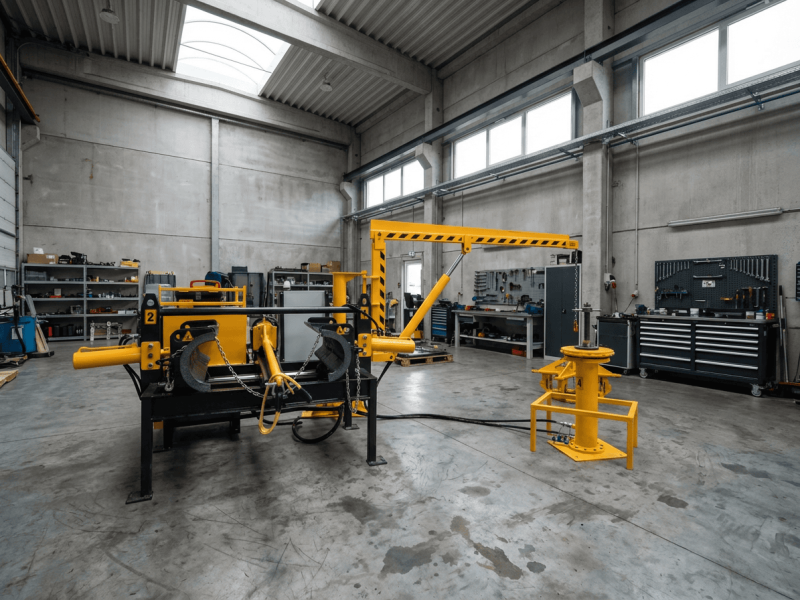
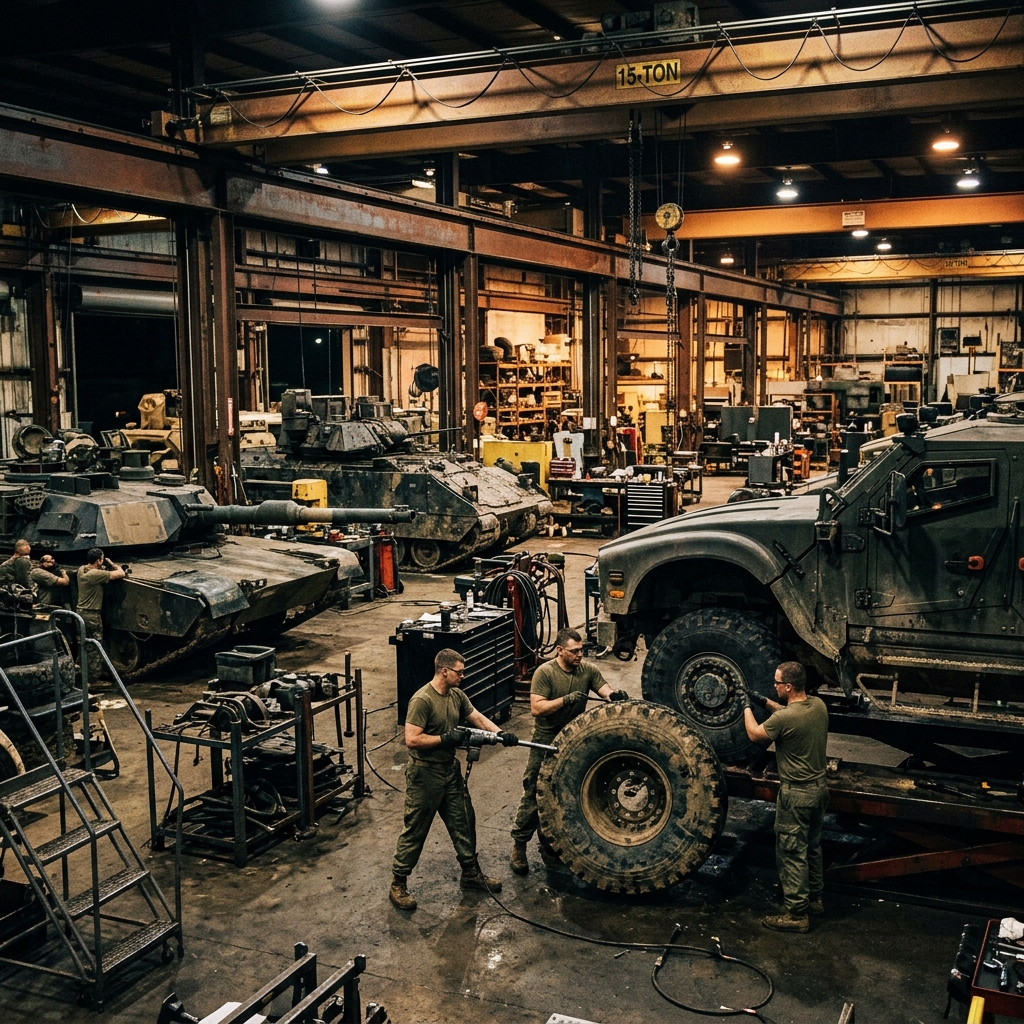
GM Defensive Workshop Model installed in military maintenance facility
GM Defensive Systems

Three Models.
One Mission: Reduce the Burden.

Each deployment model serves a different operational environment — from permanent depot to active field. The right configuration depends on where your maintenance gap is greatest.

Worldwide Deployments

These Nations Choose
GM Defensive

Over 30 countries across 5 continents rely on GM Defensive run-flat tire changing systems to maintain armored fleet readiness.

DEPLOYMENT MAP

Trusted By

0+ Organizations
The United States Army
The UAE Armed Forces
Austrian Armed Forces
Azerbaijani Armed Forces
Barzan Holdings
BMC
Canadian Armed Forces
Egyptian Armed Forces
German Armed Forces
Ghana Armed Forces
Indian Railways
Iraqi Ground Forces
Italian Army
Ivory Coast Armed Forces
Jordanian Armed Forces
Kuwait Army
Kosovo Security Force
Lebanese Armed Forces
Libyan Army
Lithuanian Armed Forces
Malaysian Army
ManTech International
Noble Supply & Logistics
Otokar
Polish Armed Forces
Pakistan Army
Portuguese Army
Qatar Armed Forces
Rheinmetall A.G
Royal Thai Armed Forces
Rwanda Defence Force
Saudi Arabian Armed Forces
Singapore Army
Slovakian Army
Somali Armed Forces
Syrian Army
Tatra Trucks a.s
Textron Systems
Tunisian Armed Forces
Turkish Army
Ukrainian Armed Forces
United Nations — UNISFA
United Nations — UNMIS

The transition from manual burden to controlled intervention is already underway across allied defense forces.